
Anchorage Alaska Property Tax Records
Anchorage property tax records are public and available online through the Municipality of Anchorage. You can search any parcel by owner name, address, or parcel ID and get assessed values, tax amounts, exemption details, and payment due dates right now. Alaska's largest city handles all its own assessment and billing through the Finance Department, making it one of the most accessible property tax record systems in the state.
Anchorage Property Tax at a Glance
Anchorage Property Tax Records Search Portal
The Municipality of Anchorage runs its property search portal at property.muni.org. This system, built in partnership with Tyler Technologies Inc and Akanda Solutions LLC, lets anyone search Anchorage property tax records without an account or fee. Every parcel record is public and available 24 hours a day.
The portal gives you three ways to find a parcel. You can search by parcel number, owner name, or site address. For parcel number searches, enter all 11 digits with or without dashes. The format looks like 009-034-57-000. Partial entries work, so you can narrow results without typing the full number. Owner name searches require the last name or business name. First name is optional. Enter names with a space only, no commas, so "Smith James" rather than "Smith, James." Partial name entries are accepted as well, which is useful when you are not sure of the exact spelling. Address searches accept a wildcard asterisk for partial matches. Searching "Oak*" returns all addresses that start with Oak. You can sort results by parcel ID, name, or address, and choose to show 15, 20, 25, 30, or 50 results per page. A map-based search is also available for users who prefer to find properties visually.
The data in the system is current as of January 1 of the tax year. That is the statutory lien date in Alaska. Any changes that happen after January 1, like new construction or rezonings, will not appear until the following year.
The Municipality of Anchorage's property search portal at property.muni.org is shown below.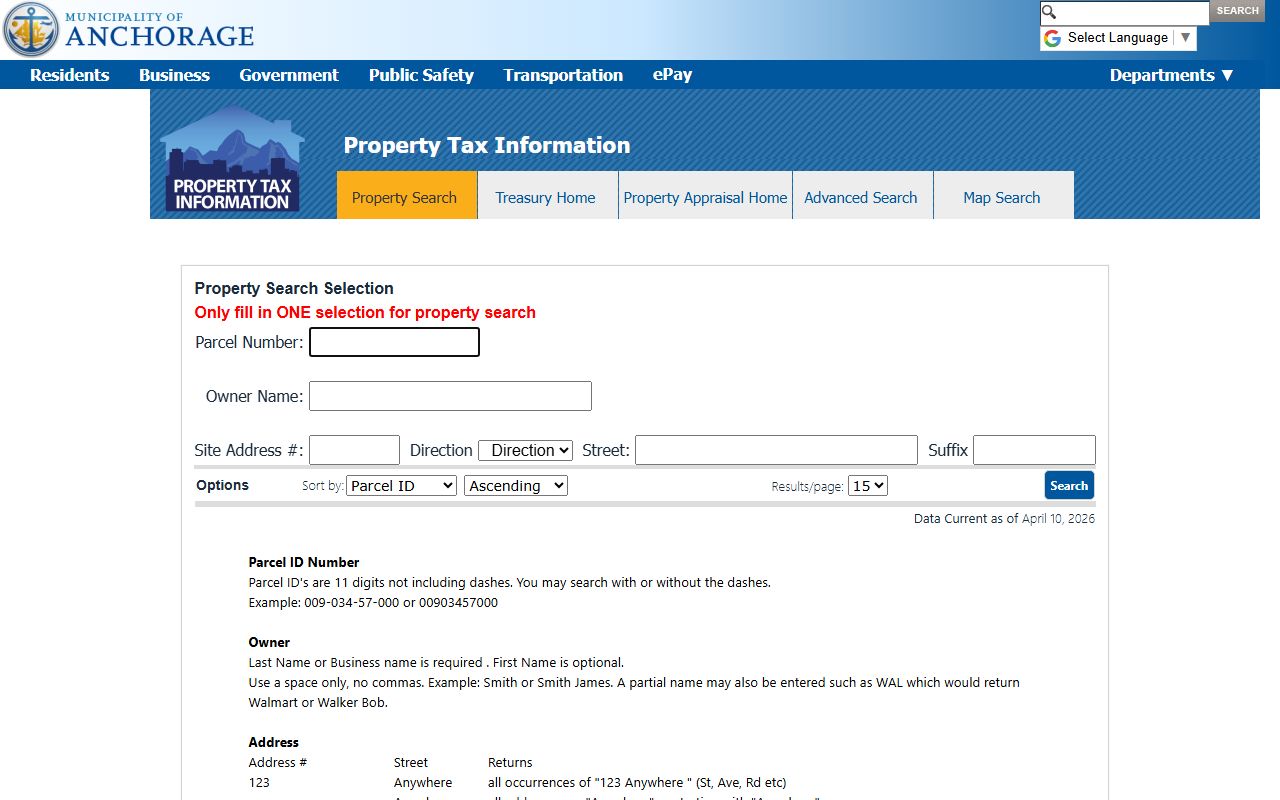
The portal is the fastest way to pull up an Anchorage property tax record. Each result shows the full parcel ID, legal description, site address, tax district, account name, and mailing address for the owner.
Note: Each parcel record also shows whether a mortgage company receives the tax bill, which is common for properties with active home loans.
What Anchorage Property Tax Records Contain
Each Anchorage property tax record includes several data fields that give you a full picture of the parcel's assessed value and tax status. The key items are the tax year assessed value, the tax amount before any exemptions apply, and then the net tax after each exemption is subtracted. Records show separate line items for the Senior Citizen and Disabled Veteran exemption, the Residential Exemption, and any Tax Credit that applies. First half and second half tax amounts are listed with their due dates, August 15 and February 15 respectively.
The legal description ties the parcel to the official plat. The tax district field tells you which service area or overlay zone the parcel falls in, which can affect the total rate. Mailing address information is included and may differ from the site address if the owner lives elsewhere. If you see a mortgage company name in the record, that company receives the tax bill directly. This is standard practice when a lender has an escrow arrangement for taxes.
If a parcel is in delinquent status, payments apply in a fixed order. Cost comes first, then penalty, then interest, and then principal. This order matters if you are researching a property with unpaid taxes and want to know how much is actually owed versus how much is fees and interest.
Anchorage Tax Billing and the Treasury Division
The Municipality of Anchorage Treasury Division handles all property tax billing and collection. The division mails tax bills once per year. Two payment installments are due: the first on August 15 and the second on February 15. You can pay online, by mail, or in person at the municipal offices.
The Treasury Division's page at muni.org/Departments/Finance/Treasury covers billing, payment options, and delinquent collection procedures.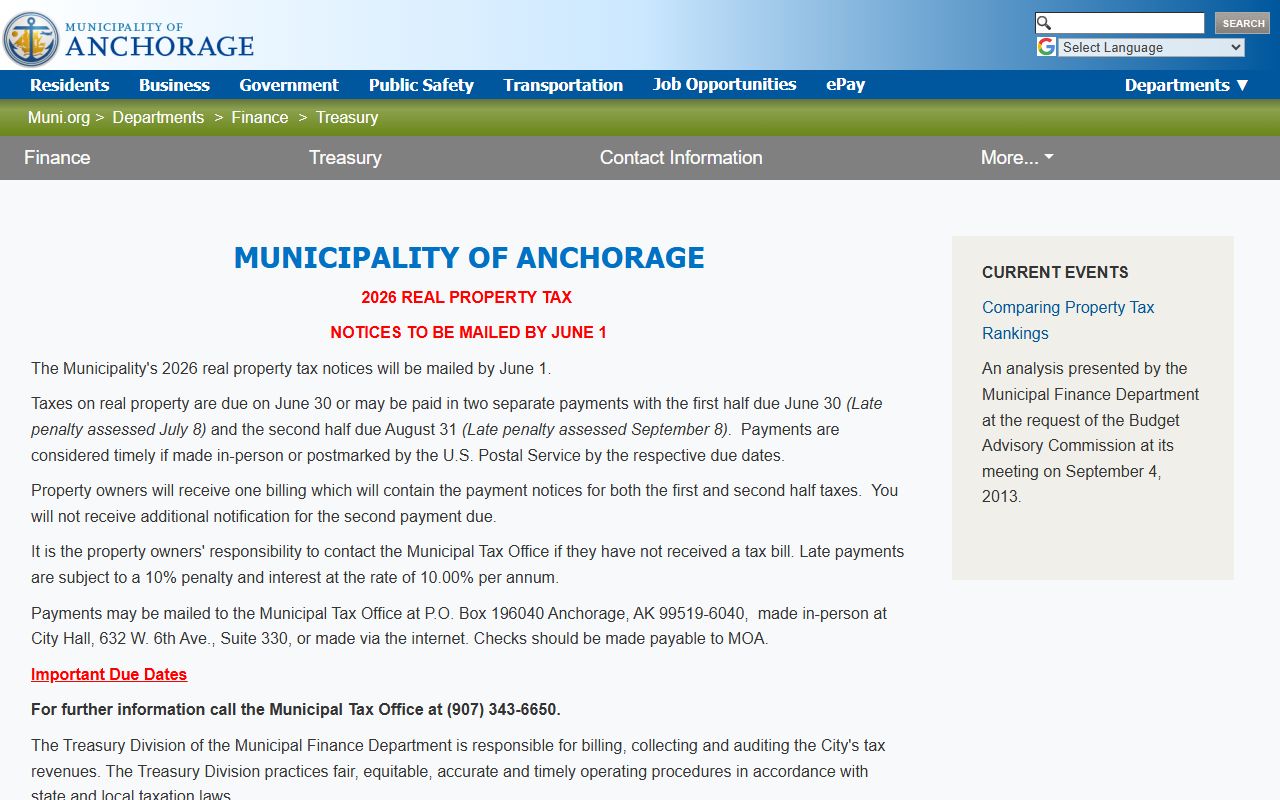
If you miss a payment, the account moves to delinquent status and interest and penalties begin to accrue. The Treasury Division manages the delinquent collection process, which can eventually lead to tax lien foreclosure.
For billing questions, the Tax Section number is (907) 343-6650. For questions about tax deed properties and Real Estate Services, call (907) 343-7953 or (907) 343-7986. The office address is 632 W. 6th Avenue Suite 330, Anchorage, AK 99501. You can also send mail to PO Box 196040, Anchorage, AK 99519-6040.
Anchorage Property Tax Exemptions
The Municipality of Anchorage offers several property tax exemptions. Each one reduces the taxable value of a qualifying property, which lowers the annual tax bill. You apply for exemptions through the Finance Department, and approvals carry forward as long as you remain eligible. Here is a quick look at the main programs:
- Senior Citizen Exemption: For residents age 65 or older who own and live in the property as their primary residence
- Disabled Veteran Exemption: For veterans with a service-connected disability rating of 50% or more
- Residential Exemption: A partial exemption on the value of a primary residence, available to qualifying homeowners
- Tax Credit Programs: Various credits that may apply based on qualifying property use or owner status
State law under AS 29.45.030 requires municipalities to grant senior citizen and disabled veteran exemptions. Anchorage also offers the optional residential exemption under AS 29.45.050. This type of exemption can reduce taxable value by up to $75,000 for a primary residence. Applications and program details are at muni.org/Departments/Finance/Tax/Exemptions. The January 15 application deadline applies each year, so do not wait until spring if you think you qualify.
Note: The state reimburses municipalities for revenue lost to the mandatory senior and disabled veteran exemptions, so those programs do not reduce borough funding the way optional exemptions can.
Anchorage C-PACER Commercial Property Program
Anchorage runs a Commercial Property Assessed Clean Energy and Resilience program called C-PACER. It applies to commercial and industrial property only. Owners can finance improvements like energy-efficient systems, renewable energy installations, or resilience upgrades through a voluntary special assessment on their property. That assessment is paid back over time through the property tax bill, so the financing follows the property, not the owner.
The program launched in April 2021 and was relaunched in 2023 after state statute changes expanded the types of eligible property and improvements. The search portal for C-PACER is at cpacer.muni.org. Interested property owners can reach the program team at CPACER@anchorageak.gov.
The C-PACER program portal at cpacer.muni.org provides detailed eligibility information for commercial property owners in Anchorage.
The program is designed for commercial and industrial owners who want to fund upgrades without a traditional loan, using the property tax system as the repayment mechanism.
How to Appeal an Anchorage Property Tax Assessment
If you think your Anchorage property tax assessment is too high, you have the right to appeal. The process starts with your assessment notice, which the municipality mails each year. You have 30 days from the date you receive that notice to file a written appeal with the Board of Equalization. Appeals must state the grounds, which can include unequal valuation, excessive valuation, improper valuation, or under-valuation of another property used for comparison. You cannot challenge the mill rate through this process. The rate is set by the Assembly and can only be contested at budget hearings.
Before filing a formal appeal, try calling the Tax Section at (907) 343-6650. Assessors can explain how they reached your value. If they find an error, they will send a corrected notice and give you 30 days from that notice to appeal. Many disputes end at this step without any hearing. If you do go to the Board of Equalization, you must present your evidence and make your case. The board's decision can be appealed to Superior Court under AS 29.45.210. From there, further appeal goes to the Alaska Supreme Court. The full legal framework for assessments and appeals is at the state's Property Assessments in Alaska page.
Anchorage Municipality and Borough Records
Anchorage is a unified home rule municipality, meaning the city and borough functions are combined in one government. There is no separate borough layer above the city. The Municipality of Anchorage covers approximately 1,940 square miles and is home to roughly 290,000 residents. It maintains 98,119 taxable real property parcels and 7,985 personal property accounts. The assessing staff of 38 operates on a $7.3 million budget. That team is responsible for discovering, listing, and valuing every taxable parcel on the same January 1 assessment date each year.
For the full borough-level overview, including the complete list of online search tools, contact details, and assessment history, see the Anchorage Municipality property tax records page.
Nearby Cities with Property Tax Records
Several communities near Anchorage are large enough to have their own property tax records pages. Each one links to local search tools and contact information for the relevant assessing office.