
Alaska Property Tax Records
Alaska property tax records are public documents kept by boroughs and municipalities across the state. Each taxing jurisdiction maintains its own records of assessed values, tax bills, exemption status, and payment history. Some boroughs offer online search portals where you can look up any parcel right now. Others require a phone call or a visit to the local assessing office. This guide covers how to find Alaska property tax records in every borough and major city, including where to search, who to contact, and what the law says about your rights as a property owner.
Alaska Property Tax at a Glance
How Alaska Property Tax Records Work
Alaska is different from most states when it comes to property tax. A large share of the land here is not taxed at all. Only boroughs and certain cities have the legal authority to levy a property tax, and not all of them do. Under AS 29.45.010, a municipality may tax real and personal property, but that power must be granted by state law. Unincorporated areas of Alaska have no legal authority to levy a property tax. Of the 19 organized boroughs and unified municipalities, only 15 collect property taxes. Among the 145 home rule, first class, and second class cities, just 21 levy a property tax in total.
All taxable property must be assessed at its full and true value as of January 1 each year. That value represents the price the property would bring in an open market sale between a willing buyer and seller, both aware of current conditions. The assessor uses mass appraisal methods, which may rely on the cost approach, the sales comparison approach, or the income approach, depending on the property type and what data is available. Once assessed, that value is the basis for your tax bill.
Tax is calculated using a mill rate. One mill equals one dollar of tax for every $1,000 of assessed value. A property assessed at $200,000 with a 10-mill rate owes $2,000. Alaska law caps the rate at 30 mills under AS 29.45.090. That cap does not apply to taxes levied to cover bonded debt. Each borough or city assembly sets the mill rate through its annual budget process, so rates vary widely across the state.
The Alaska Department of Commerce, Community, and Economic Development publishes a comprehensive overview of property tax law and requirements for all taxing jurisdictions.
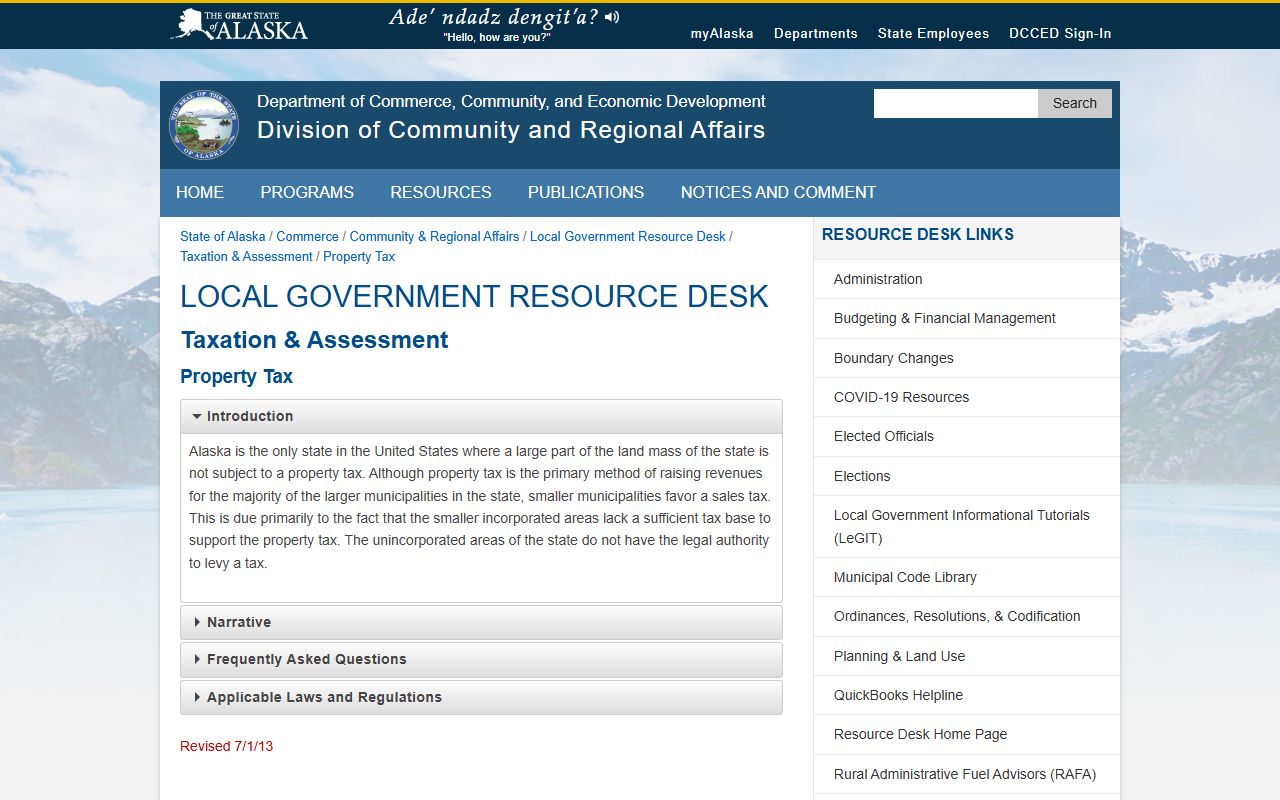
This resource covers everything from the legal framework to how boroughs set mill rates, with direct links to the statutes that govern every step of the process.
Alaska Property Assessment Process
Each local assessor is responsible for discovering, listing, and valuing all taxable property in their jurisdiction. The Office of the State Assessor provides guidance and oversight, but the day-to-day work happens at the borough level. For property owners, this means the person valuing your land and building is local and must follow both state statute and borough code.
Assessors use mass appraisal techniques to handle large numbers of properties efficiently. The cost approach works best on newer structures where there is not much sales data to compare. The sales comparison approach values property based on recent sales of similar parcels nearby. The income approach applies to properties that generate rental or business income, calculating value based on the income stream the property produces. In practice, most assessors use a mix of all three, depending on the property. Smaller communities with little market activity lean more on the cost approach. Larger ones like Anchorage and Fairbanks use all three regularly.
Assessment records are public. Under AS 29.45.160, the assessor must prepare an annual roll listing all taxable property, the assessed value, and each owner's name and address. You can view any parcel's assessment on that roll. Most major boroughs now offer online search tools. Anchorage runs its portal at property.muni.org. Fairbanks North Star Borough uses propertysearch.fnsb.gov. Matanuska-Susitna Borough offers myproperty.matsugov.us. Juneau's search is at property.juneau.org. Kenai Peninsula Borough maintains records at ak-kenai.manatron.com.
The Property Assessments in Alaska page explains how assessors determine value and what your rights are if you disagree with the result.
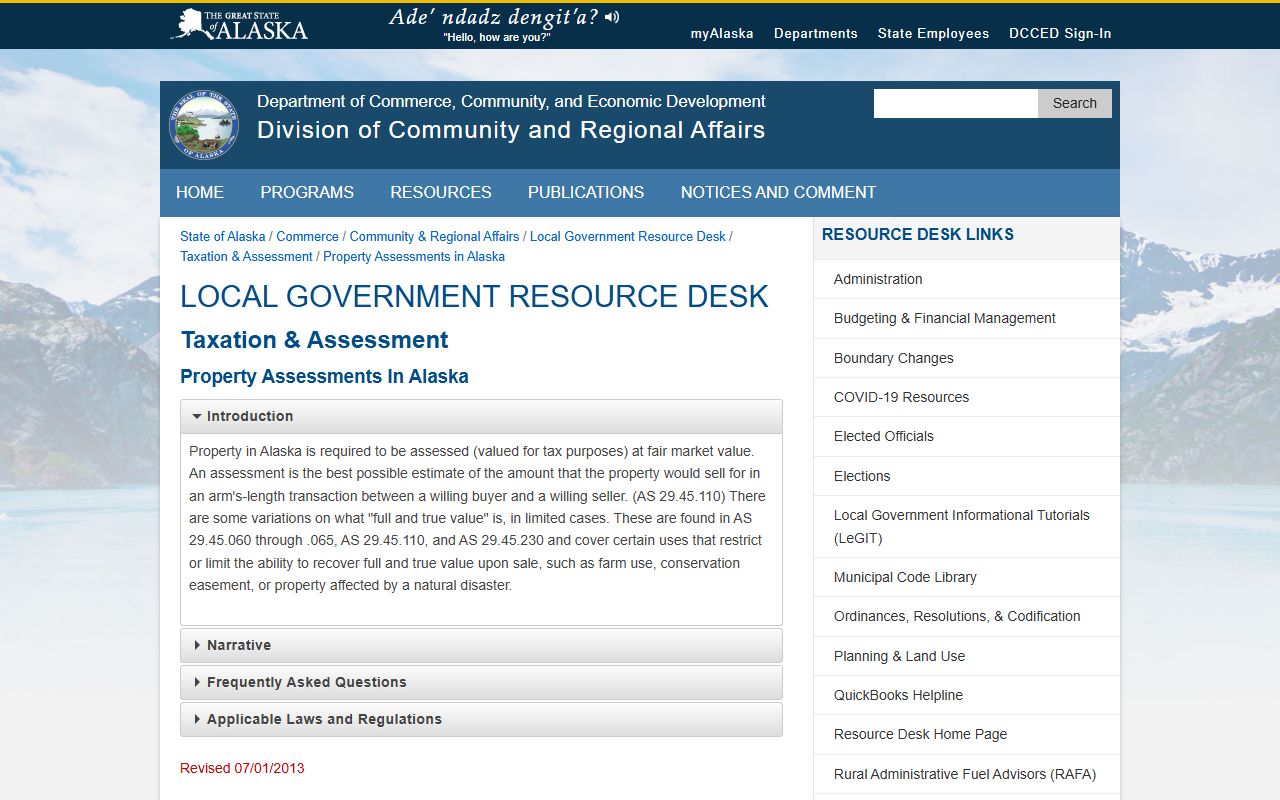
It also answers common questions about why your assessed value may differ from what you paid and how the appeal process works.
Reinspection cycles vary by borough. Anchorage follows a 6-year cycle. Fairbanks North Star inspects every 5 years. Matanuska-Susitna uses a 6-year cycle. Kenai Peninsula Borough works on a 5-year schedule. Juneau also uses 5 years. Kodiak Island Borough reinspects every 3 years, and Ketchikan Gateway Borough every 4. If you decline to let an appraiser into your home, they will value the property from the street using what they can see. Any errors that result are yours to correct during the appeal period.
Property Tax Exemptions in Alaska
Several categories of property are exempt from Alaska property taxes by law. Mandatory exemptions under AS 29.45.030 include property owned by federal, state, and local governments; property used for nonprofit religious, charitable, hospital, or educational purposes; and property owned and occupied by residents who are 65 or older as their primary residence. Disabled veterans with a service-connected disability rating of 50% or more also qualify for a mandatory exemption on their primary home. For seniors and disabled veterans, the exemption covers up to $150,000 of assessed value in most jurisdictions. Applications go to the local assessor and must be filed by January 15 each year. The state reimburses municipalities for the revenue they lose because of these mandatory exemptions.
Optional exemptions are authorized under AS 29.45.050 and must be adopted by local ordinance. Examples include exemptions for personal property, inventory held for sale, and up to $75,000 of value on a primary residence. Some municipalities exempt all personal property. Others exempt only certain categories. Property owned by Alaska Native Claims Settlement Act (ANCSA) Native corporations is also exempt unless the property is leased or developed for private use.
The State Assessor's legislation page summarizes recent changes to exemption rules, including administrative code provisions in 3 AAC 135 covering applications, deadlines, and eligibility calculations.
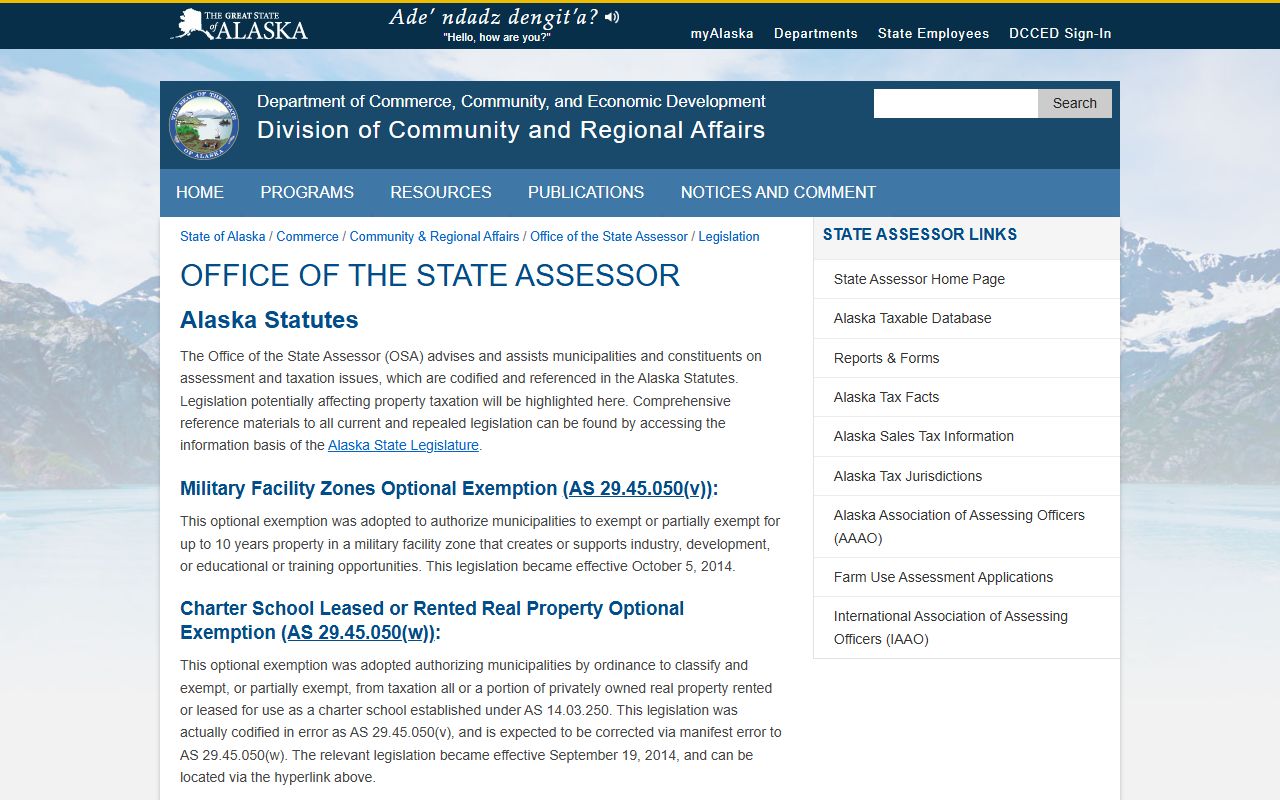
It also covers optional exemptions for military facility zones and charter school properties added through recent legislative sessions.
Appealing Alaska Property Tax Assessments
If you think your property was valued too high, you have the right to appeal. Under AS 29.45.190, you must file a written appeal with the Board of Equalization within 30 days of receiving your assessment notice. That appeal must state the grounds, which can include proof of unequal, excessive, improper, or under-valuation. You cannot challenge the mill rate through this process. Only the assessed value is subject to appeal.
Before filing a formal appeal, it helps to call the assessor's office first. Staff can explain how they reached your value. If they find an error, they will mail a corrected notice and give you 30 days from that notice to appeal. Many disputes resolve at this stage without any formal hearing. If you do proceed to the Board of Equalization, you carry the burden of proof. The board makes its decision based on your written submission and the evidence presented at the hearing. Under AS 29.45.210, a board decision can be appealed to Superior Court, and from there to the Alaska Supreme Court.
Note: The mill rate itself is not subject to appeal. It is set by the borough assembly or city council through the budget process and can only be challenged at public budget hearings.
Alaska Recorder's Office and Property Records
The Alaska Department of Natural Resources Recorder's Office maintains the official public record for every recorded document in the state. This includes deeds, mortgages, liens, easements, plat maps, and any other instrument that affects real property. The office oversees 34 recording districts that together process roughly 1,000 new documents per day. All records are public and can be accessed online or in person at recorder's offices in Anchorage and Fairbanks.
The Anchorage office can be reached at (907) 269-8875. The Fairbanks office is at (907) 452-3521. All staff are happy to show you how to use the public terminals to search the index from 1970 forward. For documents older than 1970, the office has Historic Books available on-site.
The Alaska Recorder's Office main page explains the full recording process, how documents are archived on microfilm and as digital images, and how to request copies.
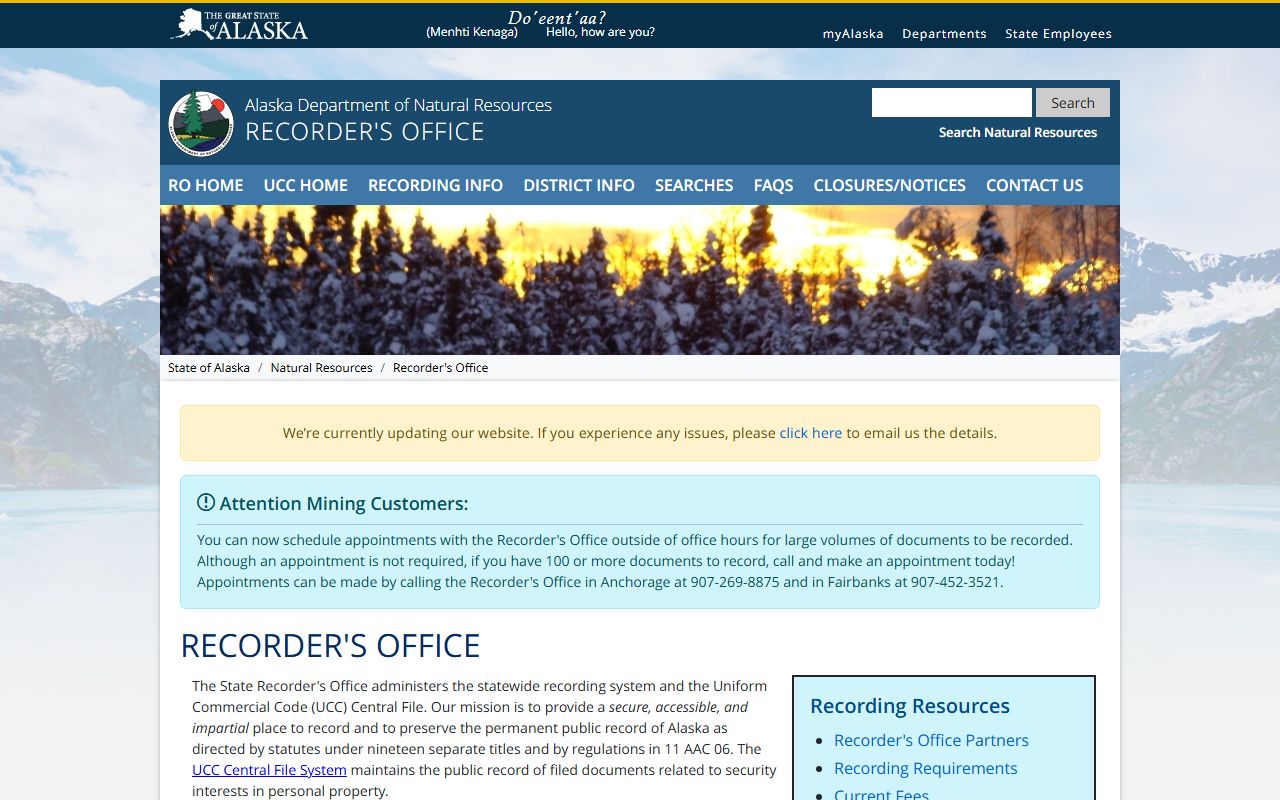
Recorded documents are indexed and available to anyone, including property owners researching their own land or prospective buyers checking for liens.
The online search portal at the Recorder's Office gives you multiple ways to find records. You can search by name, date, document number, document type, book and page, plat, survey, or using the Meridian-Township-Range-Section (MTRS) system. The system returns digital images of documents recorded since 1970.
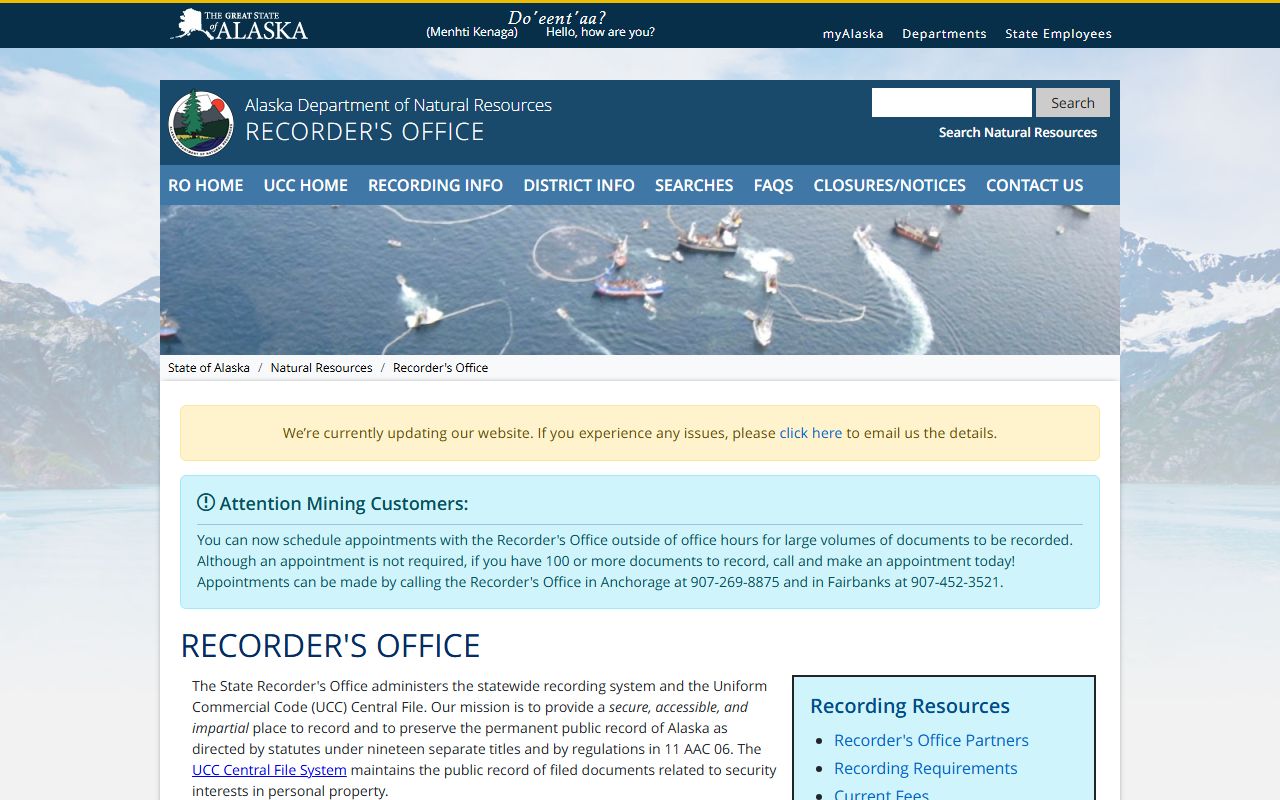
Subdivision name searches and associated document lookups are also available, making it easy to trace ownership history for any parcel in the state.
Alaska Property Tax Jurisdictions Directory
The Office of the State Assessor publishes a directory of all taxing jurisdictions at the Tax Jurisdictions Contact List. This directory includes contact details for every local assessor and contract assessor across Alaska. State Assessor Dan Nelson can be reached at (907) 269-4501 at 550 West 7th Avenue, Suite 1640, Anchorage, AK 99501.
Several boroughs use contract appraisal firms rather than in-house staff. Appraisal Company of Alaska serves Bristol Bay Borough, the City of Unalaska, the City of Valdez, the City of Wrangell, the City of Petersburg, and the City and Borough of Yakutat, among others. Skagway Municipality uses Alaska Assessment Services. For any of these jurisdictions, contact the local assessing office first. They will direct you to the right person or firm. All contact details are in the state directory.
The tax jurisdictions contact list also shows which boroughs and cities currently levy a property tax, which is important since not all do.
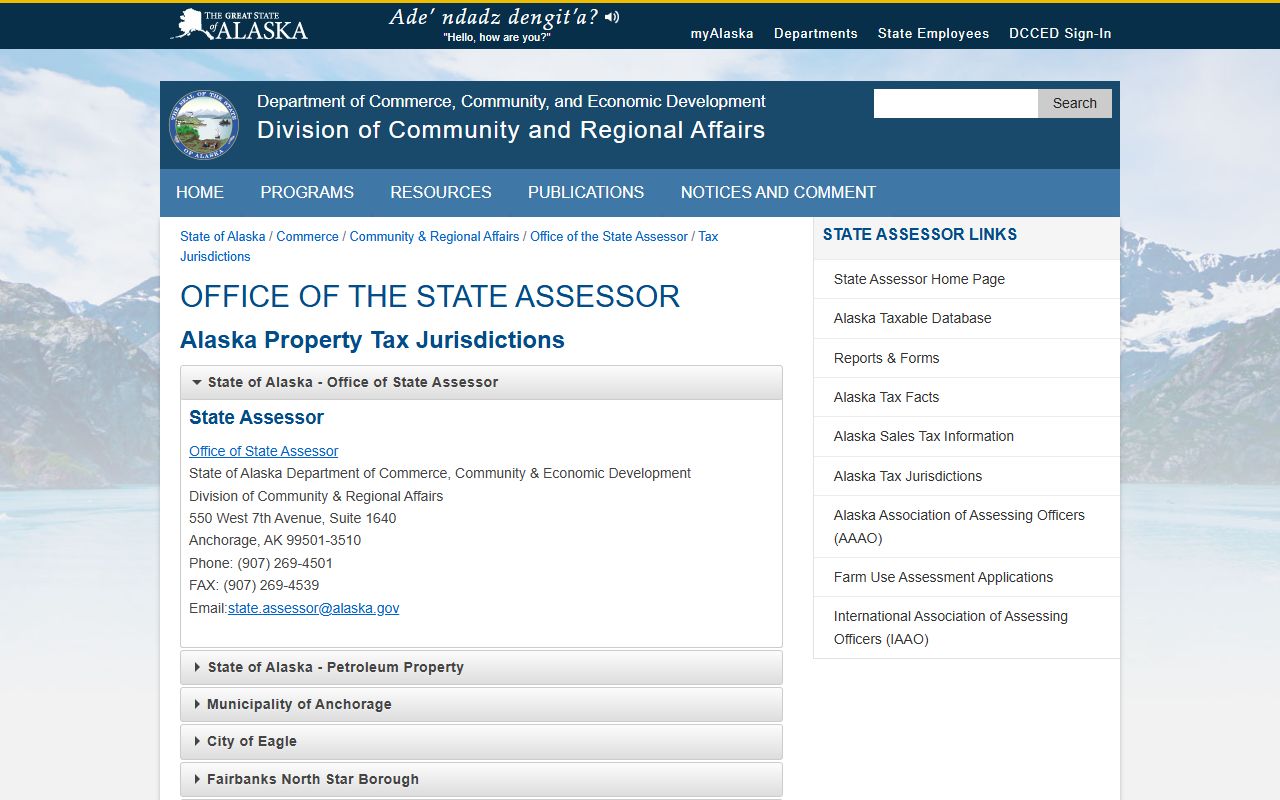
Each entry shows the assessor's name, mailing address, phone, and fax, so you can reach the right office without guessing.
Alaska Property Tax and State Revenue
Oil and gas property occupies a special place in Alaska's tax system. Under AS 43.56, the state levies a property tax of 20 mills (2% of assessed value) on property used in the exploration, production, and pipeline transportation of unrefined oil and gas. Each year, the Department of Revenue determines the assessed value of that property as of January 1. Municipalities that contain oil and gas facilities may also levy a local tax on that property at their regular rate. The local tax acts as a credit against the state levy, preventing double taxation while allowing the borough to capture some of that revenue. In fiscal year 2025, Alaska's petroleum property tax brought in $133.8 million for the state, with projections near $143 million for FY 2026.
The Alaska Revenue Sources Book, published twice a year by the Department of Revenue, tracks all state revenue streams including property tax data. It provides detailed data on oil prices, production levels, and tax projections that affect the overall fiscal picture for municipalities that share in petroleum revenues.
For boroughs with major oil and gas facilities, these numbers are a significant piece of the local budget picture.
Recent Alaska Property Tax Legislation
The Alaska Legislature actively reviews property tax law each session. You can track all current bills through the Alaska Legislature's taxation tracking page. In the 33rd Legislature, several bills addressed property tax directly. SB 179 on municipal property tax and telecommunications tax was enacted as Chapter 28 SLA 24 in August 2024. HB 347 and SB 242 both addressed property assessment procedures. Bills HB 317 and SB 161 targeted farm use land and agricultural structure exemptions. SB 265 broadened agriculture and timber tax exemptions for qualifying landowners.
Tracking legislation matters for property owners because changes to exemption thresholds, assessment procedures, or tax caps can affect what you owe. The taxation tracking page shows each bill's status, committee referrals, and whether it passed into law.
The legislature's taxation page is updated in real time as bills move through committees and floor votes.
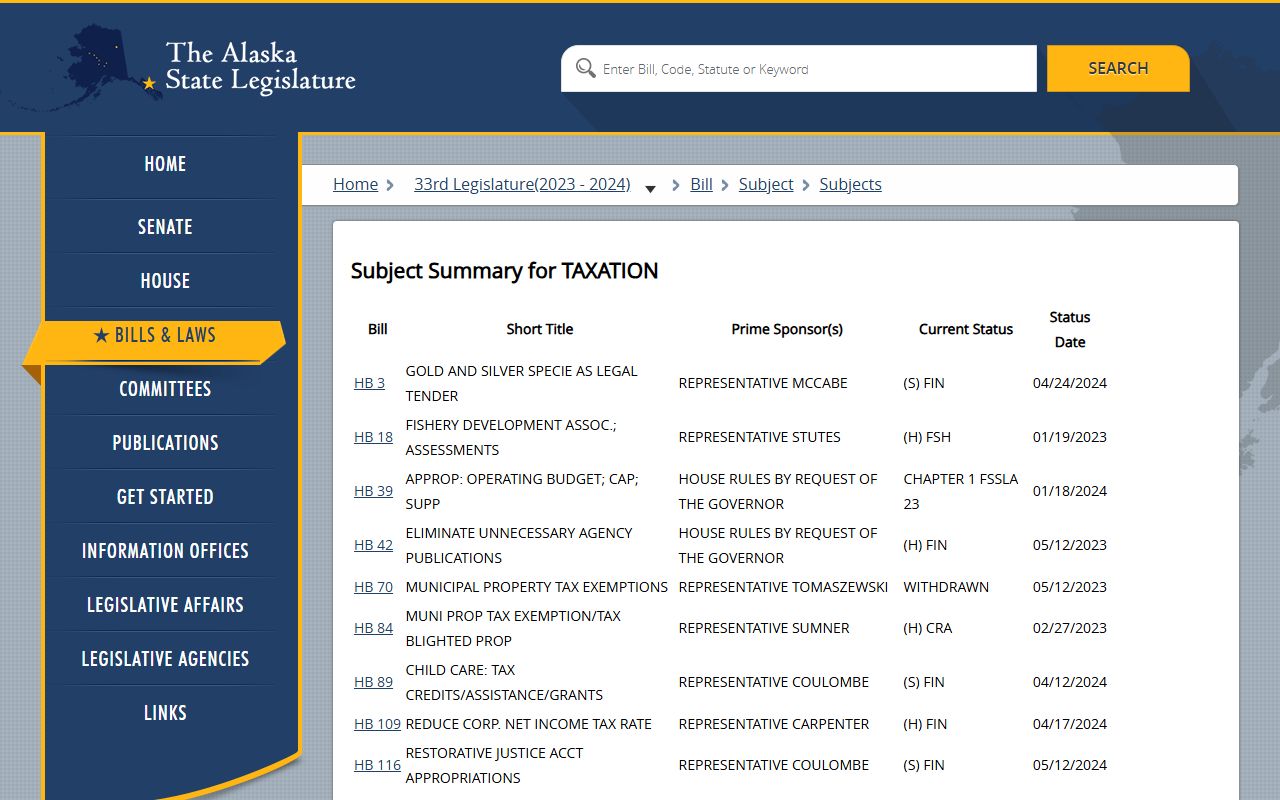
Bookmarking this page is useful if you follow changes to assessment law or local government tax authority.
Alaska Taxable Annual Report
Each year, the Office of the State Assessor releases the Alaska Taxable report. The 2024 edition is the 64th volume. It covers municipal taxation practices across the state, including Full Value Determinations for every jurisdiction. The Full Value Determination (FVD) is the total assessed value of all taxable real and personal property within a municipality's boundaries, regardless of any optional exemptions the borough may have adopted. Every municipality must report this figure to the State Assessor annually. For those that do not levy a property tax and therefore have no local assessor, the State Assessor estimates the FVD using valuation models.
The FVD has a direct effect on school funding. Under AS 14.17, each school district must make a local contribution equivalent to at least a 2.65-mill levy on the full and true value of all taxable property in the district. If a municipality does not make that contribution, it does not receive its school foundation aid payment from the state. As the FVD rises, so does the required local contribution for education. This connection between property assessment and school funding makes accurate assessment records important well beyond just the tax bill.
The major boroughs that maintain in-house assessment staff handle large portfolios. Anchorage covers nearly 100,000 real property parcels across 1,940 square miles with a team of 38 staff. Matanuska-Susitna has over 80,000 parcels across more than 25,000 square miles. Kenai Peninsula Borough maintains more than 66,000 parcels. The assessment budget at Anchorage exceeded $7.3 million in 2022. These departments carry serious responsibility for keeping records accurate and current.
The annual Alaska Taxable report is a key reference for anyone researching assessment trends, tax rates, or exemption practices across different boroughs and cities.
Browse Alaska Property Tax Records by Borough
Each borough and census area in Alaska manages property tax records independently. Select a location below to find the local assessing office, online search portals, and tax information specific to that area.
View All 30 Alaska Boroughs and Census Areas →
Property Tax Records in Major Alaska Cities
Residents of Alaska's major cities access property tax records through the borough assessing office or, in some cases, the city's own assessing department. Find resources for your city below.