
Access Dillingham Census Area Property Tax Records
Property tax records in the Dillingham Census Area depend on whether your property sits inside or outside the City of Dillingham. The census area itself is part of Alaska's unorganized borough and has no local taxing authority. The City of Dillingham, however, is an incorporated city that does levy a property tax and maintains its own assessment records through a contract assessor. This guide explains where to go for records in each situation, from the city's assessing function to state resources that cover the broader census area.
Dillingham Census Area at a Glance
Why the Dillingham Census Area Has No Borough Tax
The Dillingham Census Area is a U.S. Census Bureau designation, not a governmental entity. It has no elected assembly, no assessing office, and no legal power to levy taxes. Under AS 29.45.010, only boroughs and incorporated cities have the authority to assess and collect property taxes in Alaska. Unincorporated land in the census area falls within Alaska's unorganized borough, which has no taxing power at all.
This structure is not unique to Dillingham. A substantial portion of Alaska's land mass is in unorganized areas where no local property tax exists. This is why Alaska is often described as unusual among U.S. states when it comes to property taxation. Large areas go untaxed not because of policy exemptions, but because there is simply no local government authorized to levy a tax.
For property owners in the unincorporated parts of the Dillingham Census Area, this means no property tax bill arrives each year. Your land is still subject to recording requirements and deed registration through the state, but you will not pay local property taxes unless you live in an incorporated city or your land comes under borough jurisdiction in the future.
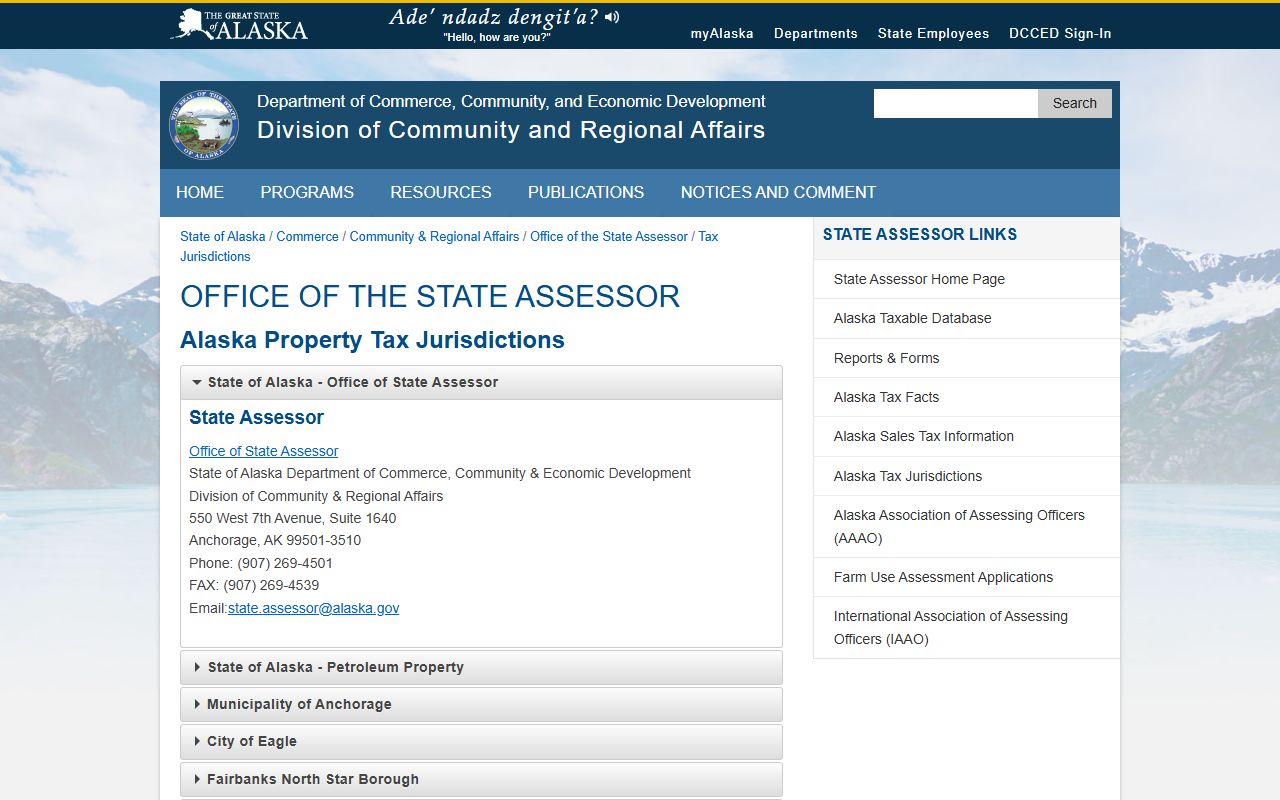
The state's tax jurisdictions contact list shows every active taxing entity in Alaska, confirming which cities and boroughs in the Dillingham Census Area levy a property tax.
City of Dillingham Property Tax Records
The City of Dillingham is an incorporated city within the census area that does levy a property tax. Assessment services are provided by a contract assessor, Appraisal Company of Alaska, which can be reached at (907) 842-5211. This firm handles property valuation, maintains assessment records, and administers exemption programs on behalf of the city.
If your property is inside Dillingham city limits, you receive an annual assessment notice. That notice shows the assessed value of your land and buildings as of January 1 of the tax year. The city council sets the mill rate through its annual budget process. One mill equals $1 in tax for every $1,000 of assessed value. So a property assessed at $150,000 with a 10-mill rate owes $1,500 in annual property tax. Alaska law caps the mill rate at 30 mills under AS 29.45.090, and that cap applies to all taxing jurisdictions in the state.
The assessor uses mass appraisal methods to value property. Depending on what data is available, this may involve the cost approach, the sales comparison approach, or the income approach. Smaller communities like Dillingham, with fewer transactions in the local market, often rely more heavily on the cost approach for residential properties. The assessor may also visit properties periodically to update records. Under state law, inspection cycles must not exceed six years.
Note: To get your current assessed value or ask about exemptions for your Dillingham property, call Appraisal Company of Alaska at (907) 842-5211. They are the direct point of contact for all City of Dillingham property assessment questions.
State Resources for Dillingham Census Area Property Records
Whether your property is inside the City of Dillingham or in the unincorporated census area, the Alaska Department of Commerce, Community, and Economic Development provides helpful state-level resources. The property tax overview page explains the full legal framework for property taxation in Alaska, including how assessments are conducted, how mill rates are set, and what exemptions property owners can claim.
For unincorporated areas, the Office of the State Assessor still estimates a full and true value for every parcel for school funding calculations under AS 14.17. Even if you do not pay a local property tax, the state's estimate of your property's value affects how much state education funding flows to schools in your area. That connection between property values and school funding is one reason the state maintains valuation data even in unorganized areas.
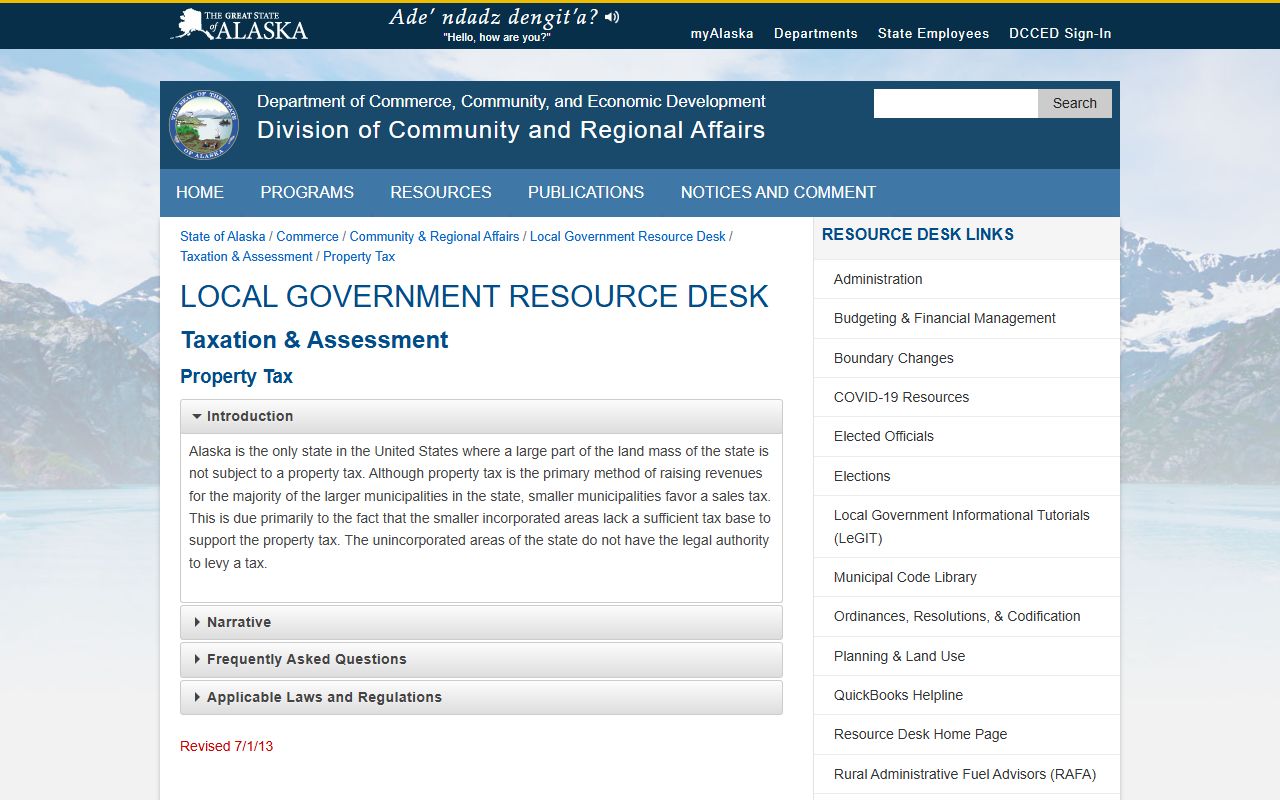
The state property tax overview is the best single reference for understanding how assessment and taxation works throughout Alaska, including in small communities like those in the Dillingham Census Area.
The Office of the State Assessor can be reached at 550 West 7th Avenue, Suite 1640, Anchorage, AK 99501, or by phone at (907) 269-4501. State Assessor Dan Nelson and his staff can answer questions about state-level valuation, school funding implications, and which taxing jurisdictions are active in the Dillingham region.
Property Tax Exemptions in the City of Dillingham
For property owners within the City of Dillingham, several exemptions may reduce the amount of tax you owe. Mandatory exemptions are required under AS 29.45.030 and cannot be waived by the city. These include the senior citizen exemption for residents who are 65 or older and occupy the property as their primary residence, and the disabled veteran exemption for veterans with a service-connected disability rating of 50% or more. Both exemptions cover up to $150,000 of assessed value, and the state reimburses municipalities for the revenue they lose due to these mandatory programs.
Optional exemptions authorized by AS 29.45.050 may be adopted by the Dillingham city council through local ordinance. These can include exemptions for personal property, business inventory, and up to $75,000 of value on a primary home. To find out which optional exemptions Dillingham currently offers, call Appraisal Company of Alaska at (907) 842-5211 and ask directly. The specific exemptions in effect change over time as the council amends local ordinances.
Exemption applications for seniors and disabled veterans must generally be filed by January 15 of the tax year. Some jurisdictions allow late filings under a waiver process, but it is best not to rely on that. If you qualify and have not applied, contact the assessor as soon as possible to get the process started. Missing a filing deadline can mean paying full tax for the year even if you would have qualified for an exemption.
Recording Property Deeds in the Dillingham Area
Deed recording throughout the Dillingham Census Area, including within the City of Dillingham, goes through the Alaska Department of Natural Resources Recorder's Office. Every deed, mortgage, lien, easement, plat map, or other instrument affecting real property must be recorded here to have legal effect against third parties. The Recorder's Office operates 34 recording districts covering the entire state. Your Dillingham area parcel will fall within one of those districts.
The online search portal at the Recorder's Office lets you look up documents by owner name, document type, document number, book and page, or the Meridian-Township-Range-Section (MTRS) land coordinate system. Digital images of recorded documents from 1970 forward are accessible online. For older records, the Anchorage and Fairbanks offices maintain historic books on site.
If you are involved in any property transaction in the Dillingham area, whether buying, selling, gifting, or refinancing, run a title search through the Recorder's Office before you finalize anything. That search will turn up any recorded liens, mortgages, easements, or competing ownership claims. For the Dillingham region, the most relevant recorder's office contact is Anchorage at (907) 269-8875, as that office covers Southcentral and Southwest Alaska.
Appealing a City of Dillingham Property Assessment
If you receive a City of Dillingham assessment notice and believe the value is too high, you can appeal. Under AS 29.45.190, you have 30 days from the date of your notice to file a written appeal with the Board of Equalization. Your appeal must state the grounds, which are limited to proof that the assessed value is unequal, excessive, improper, or represents an under-valuation. The mill rate itself is not subject to appeal.
Start by calling Appraisal Company of Alaska at (907) 842-5211 to discuss the assessment. If the assessor identifies an error in the data used to value your property, such as an incorrect lot size, wrong building dimensions, or a feature that no longer exists, they will issue a corrected assessment notice. You then have 30 days from that corrected notice to appeal if needed. Most disputes resolve at this informal stage.
If you go to a formal Board of Equalization hearing, prepare your case carefully. Bring comparable sales data, an independent appraisal, photos, or any other evidence that supports your position. The board makes its decision based on the record, and you carry the burden of proof. A board decision can be appealed to Superior Court under AS 29.45.210 and, if necessary, to the Alaska Supreme Court.
Nearby Alaska Boroughs and Census Areas
The Dillingham Census Area sits in Southwest Alaska. Use these links to find records for neighboring regions.